Monday, June 17, 2013

In the Light of Day

Frame Zero, Powdercoated
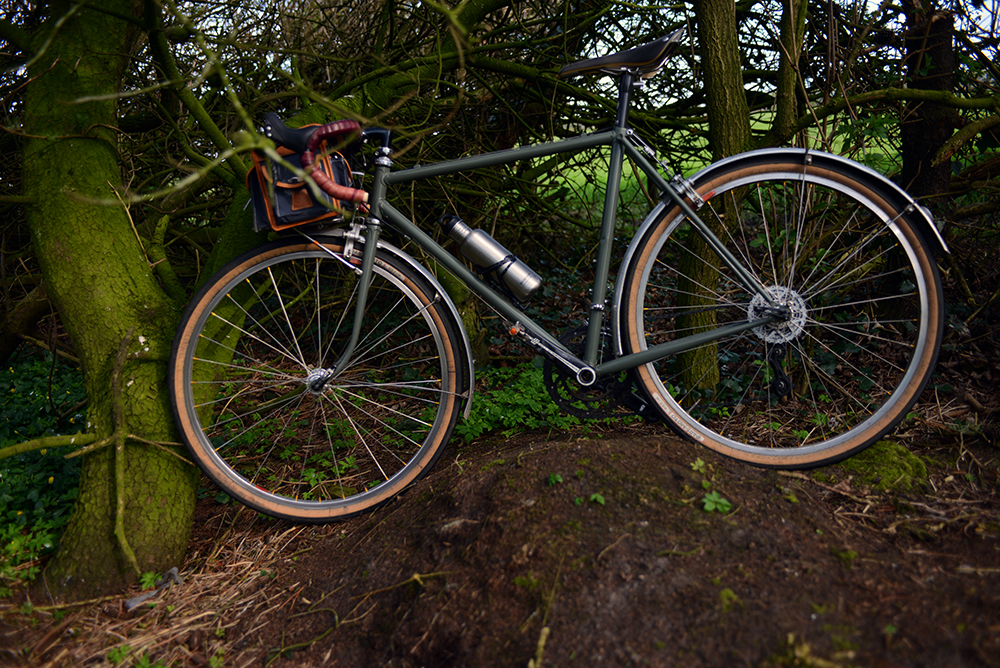
The frame I built with Mike Flanigan over the winter has long been completed and powdercoated. I've been staring at it and doing a lot of thinking... which, somehow, hasn't translated into taking any pictures. Before I knew it, a couple of months passed. And now here I am, about to skip town for much of the summer. So before setting off, I took some early morning shots of my so-called creation. 

Frame Zero, Powdercoated
When I look at this frameset and remember all that went into making it, the dominant sensations are those of physical and emotional exhaustion. I was a mediocre student. Making this thing was difficult and I struggled. It was difficult physically: The all-day filing, sanding, and even waving around the heavy torch, was exhausting for someone of my meager upper body strength. But no less difficult was the acute and constant awareness of working on something I was not good at. Of genuinely trying hard and getting at best so-so results, hour after hour and day after day. That was tough to take. 

Frame Zero, Powdercoated
So when I look at the lugwork, rather than admire its beauty I shudder at the memory of what it took to braze the joints correctly and then get the shorelines looking half-decent. 

Frame Zero, Powdercoated
The solidified mess of steel and silver that I gouged away at for hours with a variety of files to define and redefine the outlines. And don't get me started on the fork crown. 

Frame Zero, Powdercoated
Or the seat cluster with its made-from-scratch endcaps on the chainstays.

Frame Zero, Powdercoated
Brazing these on while taking care not to melt the rest of the joint, then endlessly scraping off the extra filler material in hopes of achieving at least a semblance of symmetry and elegance of form...

Frame Zero, Powdercoated
The brake bridge, which I had wanted to braze without reinforcer plates...

Frame Zero, Powdercoated
The bottom bracket, with its myriad of crevices, the tight spaces making it nearly impossible to file without gouging another tube. 

Frame Zero, Powdercoated
The acrid smell of flux. My eyes tearing up. Standing on my feet for hours at a time. The sandpaperlike texture of my fingers. The deep aches in my arms.

Frame Zero, Powdercoated
In the end, most of it looks more or less all right... except, ironically, for the dropouts. I had spent more time working on these than on any other part of the bike, and they look the worst - the one part of the frame that is glaringly amateur. The transitions are not entirely smooth and the braze on the drivetrain side betrays a couple of surface "pinholes." When pinholes happen in a lugless braze, it can be for several reasons. With small surface ones like mine it is likely mild contamination from burnt flux or metal dust. With some luck, they can be buffed out. Those pinholes kept me awake at night. I filed and buffed until I was sure I'd gotten rid of them - but somehow the powdercoat magnified rather than hid them, along with the not so smooth stay-to-dropout transitions. Naturally, this is the part of the frame I notice and think about the most. It hurts to look, but I keep looking.

Frame Zero, Powdercoated
I keep looking. And at first, maybe I feel mostly empty, numb, disappointed at my ineptitude. But with time I notice that underneath it there stirs something that almost resembles love. This thing has cut me, burned me, made me angry, made my eyes water, deprived me of sleep, and drained me of energy... What else can I do but love it.

Friday, June 14, 2013

Floods and Flowers

A ride that starts with mild rain, luring me out, ambushes with a downpour. I am too far out now to turn back. Might as well keep going.

This is all right. My tires slice through puddles.

Rain, rain, pouring rain. Drumming against my helmet. Dripping from my visor. This is okay. This is rather peaceful. The roads are all mine.

Meadow, meadow, forest, farm. Farm, farm, forest.

But darn, what's this. Country road, traffic backed up around the bend. I pedal carefully along the shoulder.

Endless line of cars, deep puddles, feet clipped in, water pouring down my face off the soggy visor, thinking "This is crazy," feeling calm, humming to myself.

A woman driver in a pickup rolls down her window. She points to my bike, then points to the back of her truck. I half-raise my hand in a half-wave like "I'm good, thanks." She shakes her head and smiles. I pass her in traffic.

Pedal, pedal, pedal. Rain, rain, rain. Cars, cars. Honking. Brake lights.

Two teenage boys in a Jeep roll down their window and lean over. "Cool bike! Cool braids!" Thumbs up to me from the teenage boys.

There is a soggy book on the grassy side of the road. Tossed by a kid out of a car window? Kittens on the cover. Bloated, wet kittens.

Let's see, what is going on at the front of all this backed up traffic...

A broken light. A ditch at the intersection filled with deep water. The bigger cars rolling though it slowly. The smaller cars frantically flashing their signals, making U-turns.

I pass them all and turn right. No one else wants to go there. What's wrong with right?

No matter. An end to the chaos. A silent empty road. Trees, trees. Darkness at noon. Streams of water across the pavement. Rain.

This is okay. This is all right. This is rather peaceful. The road is all mine. My shoe touches water on the downstroke.

And then I smell the flowers. A deep, heavy scent, almost an odor. The raindrops carry it, like perfume oil. A low-hanging branch of blossoms. I grab it and pedal home.

My bike is upside down in the kitchen. My flower, my prize is on the table. The rain has stopped, like none of it had ever happened. But water droplets glisten on the petals. And on the pedals.

Thursday, June 13, 2013

Comfortable Carbon: Trying the Parlee Z5

Parlee Z5
Looking down at my handlebars around mile 50, I felt a pang of alarm at the sight of unfamiliar decals. Then I remembered: I wasn't riding my own bike. I had gotten so comfortable, I'd forgotten. A stern voice in my head began to chastise me. "Come on, you are doing a test ride. You're supposed to be paying attention to the ride characterisics - not enjoying the scenery." Easier said than done!

To explain how I came to test ride the Parlee Z5, it may help to give a bit of a backstory. For some time, I've been interested in getting a feel for carbon fiber roadbikes. However, my attempts at this have been less than successful. I've ridden a handful of carbon bikes briefly, but either they were not set up for me to do a proper test ride, or I found the ride quality too harsh to actually want to ride them for any length of time. Of course not all carbon bikes feel the same, just like not all steel bikes feel the same. With this in mind, I finally approached the matter more strategically and talked to some industry insiders familiar with my riding style and preferences. A few suggestions kept coming up. Among them was the Parlee Z5. 

Parlee Z5
Parlee Cycles are a small and local-to-me company, based in Beverly, Massachusetts. So the idea of trying one of their bikes was appealing. Later this summer I plan to visit the factory and write about them in more detail. Parlee offers both custom frames, built on the premises, and production models designed inhouse and built in Taiwan. The Z5 is the latter. 

The demo bike was lent to me by Cycle Loft, a Boston Parlee dealer. After undergoing a fitting session, my position on the Z5 ended up near-identical to that on my own roadbike, making for a seamless transition. I kept the bike for a week and rode it for about 135 miles.  

Parlee Z5
Even before I rode the Z5, I could see why this bike was suggested to me. To call its appearance "classic" might be pushing it. But the aesthetic is clean, subtle, neutral. I did not find myself biased against it, in a "Meh, this is ugly" kind of way. In fact, I find it rather pretty. 

Parlee Z5
Made from a single carbon piece (what is known as "monocoque construction"), the Z5 frame has a seamless, sculpted look to it. At the same time, the  round tubes and the smooth, but crisply delineated joints, bear a resemblance to those of metal bikes. There are no MC Escher-esque bulges or round-to-square taperings here; the frame looks simple and familiar. For those who are curious to try carbon fiber but wince at the look they associate it with, I do think Parlee eases the transition. 

Parlee Z5
I rode the Parlee Z5 in size Small (Tall), which translates to a 52.5cm top tube and a slightly extended headtube compared to their standard Small. The complete geometry specs are here. The bike was fitted with a SRAM Force group and Mavic Ksyrium Elite wheels with 23mm Michelin Pro 4 tires (complete build specs here). Though I have Campagnolo on my own bike, I feel very comfortable with SRAM and have no trouble switching back and forth. The handlebars included in the standard build were 2mm narrower than the (42mm) bars on my own bike, but otherwise the fit was almost identical. 

Parlee Z5
The one disappointment was that the front-center was a bit tighter than I like. With 23mm tires, I had a tiny bit of toe overlap. The amount was minimal, and I still felt comfortable test riding the bike. But with 25mm tires I would not be. 

Parlee Z5
Riding the Parlee home, my first impressions were dominated by how comfortable it felt - namely, the ride quality over harsh roads, bumps and potholes. To provide some background, I am pretty sensitive to ride quality and cannot stand a bike that feels harsh. It does not matter how fast it is, how nimble, or how good at climbing: If I feel vibrations from the road or pain from going over bumps, I just can't take it for more than a few miles. This sensitivity was a big factor in my own roadbike purchasing decision a couple of years ago, and a major reason I went with a titanium Seven. So with that as my personal bike, granted I am now a bit spoiled in the ride quality department. Lots of bikes feel at least a little harsh compared to my Seven. 

Lots of bikes, but not the Parlee Z5. Nope. The Z5 was flawlessly smooth. As in zero road buzz sensation, zero pain over bumps and potholes. At some point I started intentionally riding it over every stretch of broken pavement I could find, but I couldn't feel a thing. 

Of course, whether it feels painful or not, a roadbike with skinny tires will still toss you around on bad roads. And it is here that I could feel a difference in the Z5 compared to my own bike. Until now, I had considered my Seven to be quite stiff. But after some time on the Parlee, I could feel a "give" in my own bike that I had not detected before. In comparison, there is no give to the Parlee at all; on bumpy roads it sort of bounces as one unit rather than exhibit even a slight amount of yield. 

Parlee Z5
But despite being stiffer, the Parlee did not feel harsher than my own bike, even as I rode it longer. To my surprise, neither did it feel faster. I rode alone and I rode with some fast friends. Each time, speed and effort-wise, it felt just like being on my own roadbike.

I decided to ride the Parlee on a 100K New England Randonneurs "Permanent" course I had done alone a few weeks earlier (67 miles, with 3,800 feet of climbing). Just as I'd done previously, I timed myself and genuinely tried to do my best. My average rolling speed on the Parlee was 13.3mph, whereas on my own bike it had been 13.1mph - a difference too small to be significant, considering that my fitness had also increased a bit since the earlier ride. Of course this bit of anecdotal evidence may not mean much. But it reflects my subjective experience of the bike. 

One reason I picked this particular 100K route for the test ride, was for its brief unpaved stretches. The bike rode on broken pavement so nicely, I was curious how it would do on dirt and gravel. Just as nicely, it turns out. While I prefer to do unpaved rides on wide tires at low pressure, if I must ride skinny tires the Z5 is as good as it gets. 

Parlee Z5
Aside from all this, I did feel something distinct to this bike in the course of my test rides. It was a sensation in the rear triangle - possibly the chainstays, and it was specific to cornering. It was as if the rear responded to cornering differently from what I am used to. The chainstay area felt lighter somehow, almost as if it wanted to skip or lift off on corners. Well, maybe describing it that way makes it sound too negative. Unfortunately, I don't know how to explain it any better, but I actually liked this sensation. I found the bike to be maneuverable on corners in a way I had not previously experienced.

Normally, I am pretty sensitive to a bike's front-end handling, and less so to other aspects. The Parlee was the first time I was struck by characteristics specific to the rear of the bike. 

Parlee Z5
While technically not the first carbon fiber roadbike I've ridden, the Parlee Z5 is the first one I've put a sufficient number of miles on to warrant a report. In part this is thanks to Cycle Loft, for lending it out and setting it up to fit me perfectly. And in part it's thanks to the bike's comfortable feel, which made me want to keep riding for miles and miles. Much like on my own bike, I did not experience fatigue on the Z5 after strenuous rides. And much like on my own bike, the handling, for the most part, felt "unnoticeable" - encouraging me to focus on the scenery and the ride itself, rather than on the bike. 

Going into this test ride, I had several expectations about the feel and performance of carbon fiber: Namely, that it would feel harsher, stiffer and faster than my own bike. The Parlee Z5 felt only stiffer, and even that was only noticeable to me under certain conditions. Granted, I don't race, I don't ride aggressively, I spin rather than mash, and I don't climb out of the saddle. My impressions are limited to the kind of riding I do. And that riding involves 50-100 mile jaunts, sometimes more, usually with lots of climbing and usually on bad roads. I like a fast bike that makes me feel weightless. And I also like to be comfortable. As far as that kind of riding goes, I felt right at home on the Parlee Z5. 

Tuesday, June 11, 2013

More Thoughts on Tandem Riding

I hoped that I'd get over my tandem fever by now, but instead I have only grown more curious. So when local tandemnist Matt O'Keefe offered to take me on an early morning ride, I was there with bells on. Matt and his wife Susi have been riding tandem for years. They have one for the city and one for sport, both of which Matt - production manager at Seven Cycles, and welder at Merlin prior to that - built himself.

A former mountain bike racer, Matt's attitude to cycling is "the less pavement, the better." When we set off, he suggested we do an unpaved loop instead of going on the road. I had no objections.

I was actually very interested in the logistics of how a tandem would work where we were going. The thing about dirt roads in the Boston suburbs, is that they are more like trails: For the most part not technical, but quite narrow - at times claustrophobically so, with a path through the woods just wide enough to fit a single bike. They can also be twisty. I was curious how a tandem could be wrangled around corners through some of the trickier spots.

But neither the tight turns along the narrow parts of the path nor the sharply zig-zagging boardwalks across bogs were a problem: Matt steered the long machine with precision through gravel, dirt, mud and sand, over ruts and ditches, and around tight corners. Tandems really can go anywhere! The experience from the stoker's seat was fantastic. All I had to do was pedal, and the huge bike did all this cool stuff under Matt's captaining.

In this vein, I keep mulling over the idea that tandems are a great way to expose cyclists to styles of riding they are not yet comfortable with on their own. They could be a tool not only for couples and friends of disparate abilities, but also for cycling clubs and various organised events. For instance, I can imagine a club event where experienced tandem captains offer stoker spots for tours through gorgeous but tricky terrain. Or a tandem race, with stoker positions open to cyclists who would not race on their own. Just a thought, but it could be great fun... Then again, it could turn out like this. Either way, I am in!

Monday, June 10, 2013

Arm Coolers for Summer Cycling: A Look at Rapha and DeFeet

DeFeet Armskins Ice
It is probably safe to say that most cyclists are not strangers to arm warmers. But what of their hot-weather cousins, the arm coolers? Those are a rarer beast. Worn with short sleeve jerseys, arm coolers are lightweight sleeves designed to protect from heat and sun. In intensely hot weather, wearing them is supposed to keep you cooler than cycling with bare arms or in a long sleeve jersey. So, do arm coolers work? Having tried the versions from DeFeet and Rapha, I believe they do. Here is more about them.

DeFeet Armskins Ice
Sun Protection: SPF 50 
Fabric: olefin/nylon/spandex blend
Country of Manufacture: USA
Price: $45

The DeFeet ArmSkins Ice are designed for both sun protection and abrasion protection. They are made of a rather thick, densely woven fabric that evokes medical compression wear. The texture has a striking silky sheen to it when new, though it subdues after some use. 

DeFeet Armskins Ice
The ArmSkins Ice come in two sizes: S/M and L/XL. I fit the former. Pulling these on for the first time, the fabric is so dense it feels almost reluctant to stretch. But once in place, having these on is comfortable and non-constricting. For me the length is sufficient to overlap with cycling gloves.

The ArmSkins are constructed as seamless tubes. To stay up, they use a roll-top design instead of elastic or silicone grippers. The roll tops work fairly well to keep the sleeves in place, though on long rides I do adjust them occasionally. Personally I like the roll-top: Unlike silicone grippers - it does not pinch, squeeze or chafe the skin on my upper arms, especially on long rides in hot weather. 

DeFeet Armskins Ice
Developed for temperatures over 80F and well into the 100s, the fabric of the ArmSkins Ice is described as being activated by air-flow, the "densely packed fiber molecules" causing "rapid heat exchange. If I understand correctly, the claim is that the material does not just protect the skin from outside heat, but actually sucks and expels heat from the body. According to DeFeet, the dense weave also offers abrasion protection in case of a fall or scrape - more so than a leather jacket. A technical discussion in this review describes how all of this works in greater detail. 

In use, the ArmSkins Ice feel cool to the touch, even in intense heat and sunshine. But moreover, once in a while I get the sensation of cold flashes along my arms. This happens in the absence of any breeze, but it does happen more when I ride fast, which probably means it is caused by increased air flow. To feel a chill on my arms in 90F heat and direct sun is quite something. I cannot comment on the abrasion protection, but the cooling properties of this garment are impressive. Wearing the DeFeet ArmSkins Ice feels like having an air conditioning system wrapped around my arms. 

Rapha Arm Screens
Sun Protection: SPF 50 
Fabric: polyester/elastane blend
Country of Manufacture: Turkey
Price: $45 

The Rapha Arm Screens are made of a stocking-thin fabric. They weigh next to nothing and, crumpled-up, will easily fit into the meagerest of jersey pockets. Pulling them on, the material hardly registers between the fingertips. 

Rapha Arm Screens
The Arm Screens are shaped, with bonded seams running along the inside of the arm and articulated elbows. Reflective logos sit just above the wrists. 

The sizing (XS-L) is similar to Rapha's arm warmers - which is to say, they run small. However, they are also very stretchy, so there is some leeway. I am a US woman's size 4 with arms of average thickness and below-average muscle tone. I can fit into the Small, but the Medium feels more comfortable - with no sausaging effects and with length to spare. For those unsure about their size, I would suggest erring on the larger side: The longer length will ensure there is no gap between the Screens and your cycling gloves. 

Rapha Arm Screens
The Screens stay up with the help of elasticised bands, which are as thin as the rest of the fabric. There is no silicone gripper and, compared to other designs, the hold is gentle - not pinching or squeezing the skin at the top. But the bands have worked well for me so far. For example, they kept the Arm Screens in place for over 15 hours straight on a recent long ride. The fabric feels delicate, though after some weeks of rough handling I have not snagged it yet. 

The "proprietary stretch Swiss fabric" used to make these is a polyester/elastane blend with "coldblack technology to keep the fabric cool against the skin." It has also been subjected to "anti-microbial/anti-bacterial treatment." Beyond this, Rapha does not elaborate. But whatever the technology is, it works. Wearing the Arm Screens pretty much feels like not wearing anything at all. I do not notice them on, other than that my arms feel cooler. Compared to riding bare-armed, I do not feel the heat or the burn of the sun's rays against my skin. Perspiration does not gather on any parts of my arms and removing these after a long ride, they are dry. The Rapha Arm Screens protect from sun and heat, while feeling weightless and comfortable on all-day rides. 

Rapha Arm Screens
Identical in price point and SPF rating, the arm coolers from DeFeet and Rapha offer different technologies to deal with intense summer weather. A benefit specific to the DeFeet ArmSkins ICE is their added abrasion protection. A benefit specific to the Rapha Arm Screens is their weightlessness. Perhaps an obvious caveat - but both tend to get dirty in use, so do not expect them to remain bright-white for long. 

Similar products worth checking out include Voler Sol SkinsPearl Izumi Sun Sleeves, Novara Sun SleevesSugoi Arm Coolers, Craft ProCool Compression Coolers and DeSoto Arm Coolers - though I have not tried any of these myself.